

Understanding Tunable Diode Laser Absorption Spectroscopy in Simple Terms
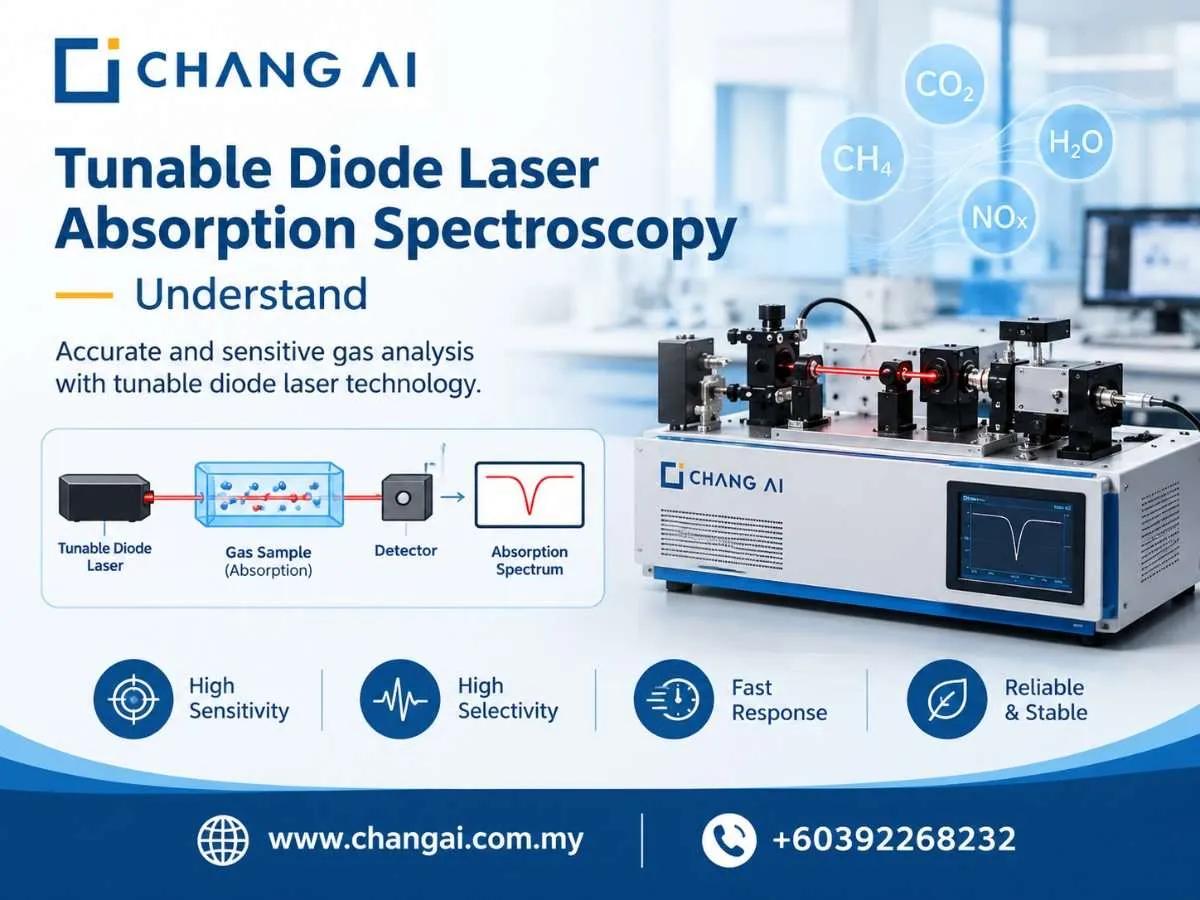
Tunable Diode Laser
Tunable diode laser absorption spectroscopy (TDLAS) is a technique based on the detection and measurement of specific gasses by a laser beam. The laser is tuned to a wavelength that is absorbed by a target gas. The system measures the amount of light passing through a sample of gas, then calculates the concentration of the gas with high accuracy and speed—all without physically touching the gas.
If you are working in instrumentation or industrial gas measurement, you have probably heard the term tunable diode laser at some point. It sounds complicated, but the basic idea is surprisingly simple. Light travels through a gas. Some of the light is absorbed. The amount absorbed tells you what gas there is, and how much of it there is. That is the essence of TDLAS – and it is one of the most reliable methods employed in gas concentration measurement today.
What Is the TDLAS Principle?
The TDLAS principle is built on a well-established physical law: every gas molecule absorbs light at specific, unique wavelengths. These wavelengths act like a molecular fingerprint. No two gases absorb light in exactly the same pattern, which makes laser absorption spectroscopy an extremely selective measurement technique.
Here is how it works in a basic sequence:
A semiconductor diode laser emits light at a carefully controlled wavelength.
The laser wavelength is tuned — adjusted slightly — to match the absorption line of the target gas.
The laser beam passes through the gas sample in a measurement cell or across an open path.
A photodetector on the other side captures the transmitted light.
The system compares the emitted and received light intensity to calculate the gas concentration.
This comparison follows the Beer-Lambert Law, which states that the amount of light absorbed is directly proportional to the concentration of the absorbing gas and the path length of the beam through the gas.
Why "Tunable"? What Does That Mean?
The secret that distinguishes this technology from ordinary laser systems is the word “tunable.” The wavelength of a normal laser is fixed. A tunable diode laser is capable of sweeping its output over a narrow range of wavelengths by varying the injection current or the temperature of the diode.
It is this tunability that makes the system selective. Instead of detecting all of the gasses present, it looks for a particular gas, scanning across its known absorption wavelength. For example , to monitor methane ( CH4 ) the laser is tuned to about 1653 nm , a wavelength at which methane absorbs strongly but other common gasses do not significantly interfere .
This precision eliminates the need for filters, reference cells, or complex optical components that are relied upon by older spectroscopy methods.
How Gas Concentration Measurement Actually Works
The Role of Absorption Lines
Every gas has a set of absorption lines — narrow spectral features at specific wavelengths where the molecule transitions between energy states. TDLAS targets one of these lines with precision. The narrower and more isolated the absorption line, the more accurate the measurement.
Databases like HITRAN (High-Resolution Transmission Molecular Absorption Database) provide catalogued absorption data for hundreds of gases. Engineers use this data to select the ideal wavelength for a given measurement application.
Signal Processing: From Raw Data to Gas Reading
The detector doesn't just measure the raw light intensity. Modern TDLAS systems employ a technique called Wavelength Modulation Spectroscopy (WMS). In this case the laser wavelength is modulated with a high frequency. The detector then searches for signals at twice the frequency — the so-called 2f signal — which maps directly to the gas’s absorption feature.
This technique greatly enhances the sensitivity. It enables the system to detect gas concentrations in the parts-per-million (ppm) or even parts-per-billion (ppb) range, even in noisy industrial environments.
Where Is TDLAS Used in Industry?
TDLAS is not a laboratory curiosity. It is actively deployed across demanding industrial sectors, particularly in Malaysia and across Southeast Asia, where process efficiency and safety compliance are increasingly critical.
Common application areas include:
Oil and gas: Monitoring flammable gases such as methane and hydrogen sulphide in pipelines and process streams.
Power generation: Measuring oxygen and carbon monoxide inside boilers and combustion chambers, where physical probes would fail under extreme heat.
Semiconductor manufacturing: Detecting trace moisture (H₂O) and oxygen at ppb levels in ultra-pure process gas streams.
Chemical processing: Measuring ammonia, HF, HCl, and other corrosive or toxic gases in real time.
Environmental monitoring: Measuring stack emissions and greenhouse gases for regulatory compliance.
In each case, the non-contact, in-situ nature of laser absorption spectroscopy gives it a clear advantage over conventional electrochemical or paramagnetic sensors, which require gas extraction and conditioning before analysis.
TDLAS vs. Traditional Gas Analysers: A Quick Comparison
Feature | TDLAS | Traditional Gas Analyser
|
|---|---|---|
Measurement type | In-situ, non-contact | Extractive, contact-based |
Response time | Milliseconds to seconds | Seconds to minutes |
Sensitivity | ppm to ppb level | Typically ppm range |
Cross-sensitivity | Very low (highly selective) | Moderate to high |
Maintenance | Low (no moving parts) | Higher (filters, pumps, cells) |
Calibration frequency | Low | Regular calibration required |
Key Advantages for Instrumentation Engineers
From an engineering standpoint, what makes TDLAS particularly compelling is its resilience in harsh conditions. Sensors that need to be inserted into a process stream face corrosion, fouling, and mechanical wear. A laser-based system mounted outside the process — firing a beam across a duct or through a window — avoids all of that.
Here are the practical benefits engineers consistently value:
Zero drift over time: Because measurements are based on fundamental physical absorption constants, TDLAS instruments do not drift the way electrochemical sensors do.
Fast dynamic response: Suitable for control loops where real-time feedback matters.
Multi-component capability: Some systems can measure temperature and pressure simultaneously using the same spectral scan.
Safe for hazardous areas: Non-intrusive measurement is inherently safer when dealing with explosive or toxic gas streams.
Understanding the Limitations
TDLAS is not without constraints. Engineers should be aware of these before specifying a system:
Limited to specific gases: Each analyser is optimised for one or a few target gases. Broad-spectrum analysis requires additional instruments.
Optical path alignment: In open-path configurations, dust, vibration, or misalignment can interrupt the beam and affect readings.
Interference from other absorbing species: Although highly selective, in complex gas mixtures with overlapping absorption lines, careful wavelength selection and signal processing are needed.
Cost: Initial investment is higher than basic electrochemical analysers, though total cost of ownership over time is typically lower due to reduced maintenance.
A Practical Example: Measuring Oxygen in a Boiler
Consider a utility boiler running on natural gas. The combustion team needs to maintain the flue gas oxygen level within a tight band — too much means wasted fuel; too little means incomplete combustion and CO formation.
A TDLAS oxygen analyser is mounted directly on the flue duct. The laser fires across the duct through optical flanges. Within seconds, the system reports oxygen concentration at actual process temperature and pressure — no sample extraction, no conditioning system, no delay. The control system adjusts the air-to-fuel ratio in real time.
This kind of in-situ, real-time feedback simply is not achievable with traditional extractive systems that take minutes to cycle a sample.
What Students Should Take Away
If you are studying instrumentation or process engineering, TDLAS is worth understanding at a fundamental level because it demonstrates how physical chemistry translates directly into engineering solutions. The Beer-Lambert Law, molecular energy transitions, and optical detector physics all come together in a single, elegant measurement system.
Start by getting comfortable with these three concepts:
Absorption lines: Every gas has unique spectral fingerprints. TDLAS exploits this.
Beer-Lambert Law: Concentration is proportional to the logarithm of the ratio of incident to transmitted light.
Wavelength modulation: WMS improves sensitivity by filtering out background noise at the modulation frequency.
These building blocks will help you understand not just TDLAS, but the broader family of optical gas measurement technologies.
Choosing the Right TDLAS Analyser
When specifying a TDLAS system, consider these factors:
Target gas and required detection range (ppm vs. %, volumetric vs. mass concentration)
Process conditions: temperature, pressure, dust loading, and path length available
Whether in-situ or extractive measurement is more appropriate for your application
Hazardous area classification requirements (ATEX, IECEx, or SIRIM standards in Malaysia)
Integration with existing control systems (4–20 mA, HART, Modbus, PROFIBUS)
Reputable suppliers will provide application engineering support to match the right technology configuration to the specific process conditions. For those operating in Malaysia's oil and gas, power, or chemical industries, Chang Ai offers optical gas analysers with technical support tailored to regional industry requirements.
FAQ
What is tunable diode laser absorption spectroscopy used for?
TDLAS is applied in industrial processes, environmental monitoring and safety applications for measurements of concentration of some gasses. The method works by tuning a laser to the exact wavelength a target gas absorbs and measuring the reduction in transmitted light intensity to calculate gas concentration accurately.
How does the TDLAS principle differ from conventional infrared gas analysers?
Unlike broadband infrared analyzers that utilize a broad light source and optical filters, TDLAS employs a single wavelength laser precisely tuned to a gas absorption line. This gives TDLAS a much higher selectivity, faster response and higher sensitivity - typically in the ppm or ppb detection limit without the need for extraction of a gas sample.
What gases can be measured using laser absorption spectroscopy?
TDLAS can measure a wide variety of gasses including oxygen (O 2 ), carbon monoxide (CO), carbon dioxide (CO 2 ), methane (CH 4 ), ammonia (NH 3 ), hydrogen sulfide (H 2 S), moisture (H 2 O) and hydrogen fluoride (HF). The operating wavelength depends on the target gas and is usually in the near-infrared to mid-infrared spectral region.
Is TDLAS suitable for use in hazardous industrial environments?
Yeah TDLAS is a non-contact, non-intrusive measurement technique, which makes it ideal for use in explosive, toxic or high temperature environments. The laser source and detector are external to the process and are therefore not a source of exposure, and do not require intrusive probe assemblies and regular maintenance.
What is the Beer-Lambert Law and why does it matter in TDLAS?
The Beer-Lambert law states that the absorption of light is proportional to the concentration of the absorbing substance and the optical path length. In TDLAS this law is the mathematical basis for the conversion of the measured drop of laser-intensity in a precise gas concentration value in the process stream.
How often does a TDLAS analyser need to be calibrated?
TDLAS analyzers typically require less frequent calibration than electrochemical or catalytic sensors. The zero point is inherently stable, as the measurement is based on fixed molecular absorption constants, not chemical reactions. Most TDLAS systems are validated annually, with some designs capable of self-validation using reference cells.